
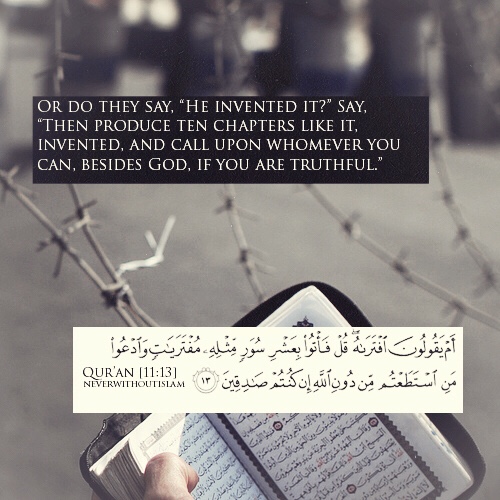
Allah عزوجل , in the Quran itself has promised its preservation:
إِنَّا نَحْنُ نَزَّلْنَا الذِّكْرَ وَإِنَّا لَهُ لَحَافِظُونَ
Verily We: It is We Who have sent down the Dhikr (i.e. the Quran) and surely, We will guard it (from corruption). [15:9]
إِنَّ الَّذِينَ كَفَرُوا بِالذِّكْرِ لَمَّا جَاءَهُمْ ۖ وَإِنَّهُ لَكِتَابٌ عَزِيزٌ
Verily, those who disbelieved in the Reminder (i.e. the Quran) when it came to them (shall receive the punishment). And verily, it is an honourable respected Book (because it is Allah’s Speech, and He has protected it from corruption, etc.). (See V. 15:9 above] – [41:41]
لَا يَأْتِيهِ الْبَاطِلُ مِنْ بَيْنِ يَدَيْهِ وَلَا مِنْ خَلْفِهِ ۖ تَنْزِيلٌ مِنْ حَكِيمٍ حَمِيدٍ
Falsehood cannot come to it from before it or behind it (it is) sent down by the All-Wise, Worthy of all praise (Allah).[41:42]
So the Quran, since it’s revelation has been protected from any sort of curruption of its original content, the fact that it has remained unchainged since its revelation is testimony to this fact.
As Islam has spread throughout the world many non Arabic speakers have embraced it, at the same time, a depletion of the correct understanding of the Ayats, away from the understanding which the Sahabah had based on the Prophet ﷺ explaining the Quran to them.
بِالْبَيِّنَاتِ وَالزُّبُرِ ۗ وَأَنْزَلْنَا إِلَيْكَ الذِّكْرَ لِتُبَيِّنَ لِلنَّاسِ مَا نُزِّلَ إِلَيْهِمْ وَلَعَلَّهُمْ يَتَفَكَّرُونَ
With clear signs and Books (We sent the Messengers). And We have also sent down unto you (O Muhammad SAW) the reminder and the advice (the Quran), that you may explain clearly to men what is sent down to them, and that they may give thought.
[An-Nahl, Ayah 44]
This depletion in correct understanding has occurred due a number of reasons. What is important to understand, is that those who have attempted to distort the Quran have done so to the meaning and understanding.
Firstly, what is the correct and agreed upon method of understanding the Quran? There is consensus from the main stream scholars, past and present that the Quran is firstly understood or explained by way of the Quran itself, then by way of the sunnah (i.e. the narrations of the Prophet ﷺ), then by way of the narrations of the Companions رضي الله عنهم , then by way of statements of the Successors of the Companions and then finally the Arabic language. Verily this sequencing is the correct method adapted by the mainstream classical and contemporary works of tafsir (exegesis).
From the very outset of its revelation, many have tried to attack the Quran. From the earliest of such attacks were from the Quraish..
The Quraish repeated accuse Prophet Muhammad ﷺ for being a forger, a soothsayer etc. Interestingly enough, these old arguments are recycled again and again by the people even today! The Arabs who were at the pinnacle of their poetry and prose during the time of revelation of the Qur’an could not even produce the smallest surah of its like. Poetry in Arabic falls into sixteen different al-Bihar. The Qur’an’s form did not fit into any of these categories. It was this that made the Qur’an inimitable, and left the Quraish Arabs at a loss as to how they might combat it. Perhaps the following famous account of Umar Ibn Khattab demonstrates this best.
[1] One day, Umar Ibn Khattab رضي الله عنه set out from his house, and headed for the Holy Sanctuary where he saw the Prophet ﷺ offering prayer and overheard him reciting the begging of Surah Al Haqqah. (The Prophet ﷺ could not see Umar Ibn Khattab رضي الله عنه) Umar رضي الله عنه said to himself “by Allah this is poetry as the Quraish have said. ” At that moment, the Prophet recited:
إِنَّهُ لَقَوْلُ رَسُولٍ كَرِيمٍ
That this is verily the word of an honoured Messenger [i.e. Jibrael (Gabriel) or Muhammad ﷺ which he has brought from Allah]. [69:40]
وَمَا هُوَ بِقَوْلِ شَاعِرٍ ۚ قَلِيلًا مَا تُؤْمِنُونَ
It is not the word of a poet, little is that you believe! [69:41]
Then immediately Umar رضي الله عنه, said to himself “he is a soothsayer”, immediately after, the Prophet ﷺ recited
وَلَا بِقَوْلِ كَاهِنٍ ۚ قَلِيلًا مَا تَذَكَّرُونَ
Nor is it the word of a soothsayer (or a foreteller), little is that you remember! [69:42]
تَنْزِيلٌ مِنْ رَبِّ الْعَالَمِينَ
This is the Revelation sent down from the Lord of the ‘Alamin (mankind, jinns and all that exists). [69:43]
[2] Umar رضي الله عنه, himself narrates “Then Islam came into my heart”
Attacks by way of incorrect translation
As briefly mentioned earlier, it became clear in the minds of the enemies of Islam, through the generations that the Quran could neither be tampered with and nor be reviled from any angle. As Islam spread through the world and many non-Arab speaking people were embracing Islam, there came a need to produce translations of the Quran. Due to the pure eloquence of the Quran and its linguistic beauty no translation can ever do its meaning justice, rather translation can only give a short perspective of the meaning and provide only a limited understanding of the message.
Nevertheless, there are some translations which are particularly bad and contain significant errors, which can lead the one unaware of the Arabic language susceptible to forming an incorrect creed and due to the wide circulation of these translations on can only assume they have been created in order to attack the pure message of the Quran. I will give some examples below to illustrate my point, it must be noted however that these are only a few examples.
Examples:
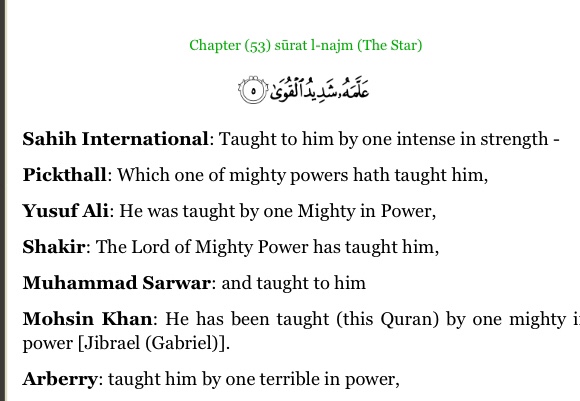
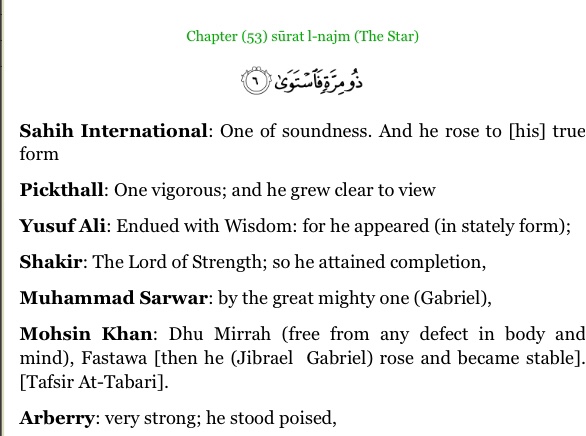
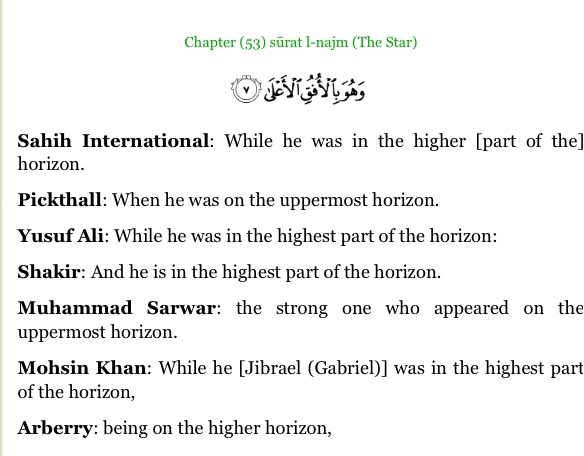
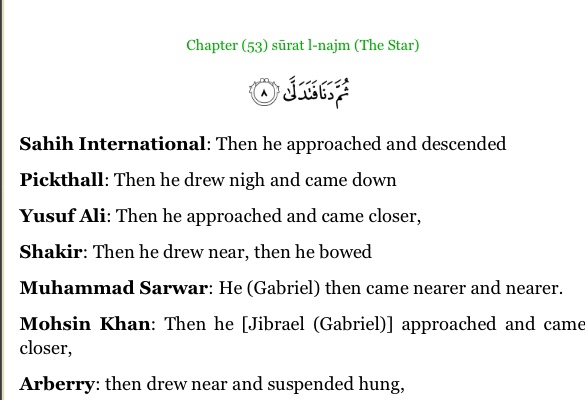
You can see in the above verses from Surah Najm that most of the widespread translations do not make clear who it was that approached the Prophet ﷺ , except for Mohsin Khan’s translation. These beautiful verses in Surah Najm describe the Isara wa Miraj, when Jibreel came to the Prophet in his true form. In verse 6, Shakir, translation goes to the extent of confusing Jibril عليه السلام with Allah عزوجل!
If we look at the tafsir of Ibn kathir for the above verses we can see that Mohsin Khan’s translation has clearly taken into account the prophetic narrations in his translation:
Allah عزوجل states that the Message His servant and Messenger Muhammad ﷺ brought to people was taught to him by,
﴿شَدِيدُ الْقُوَى﴾
(mighty in power), he is Jibril, peace be upon him,
﴿إِنَّهُ لَقَوْلُ رَسُولٍ كَرِيمٍ ذِى قُوَّةٍ عِندَ ذِى الْعَرْشِ مَكِينٍ مُّطَـعٍ ثَمَّ أَمِينٍ ﴾
(Verily, this is the Word a most honorable messenger, owner of power, with (Allah) the Lord of the Throne, obeyed (by the angels) and trustworthy.)(81:19-21) Allah عزوجل said here,
﴿ذُو مِرَّةٍ﴾
(Dhu Mirrah), meaning, he is mighty in power, according to Mujahid, Al-Hasan and Ibn Zayd. In an authentic Hadith from `Abdullah bin `Umar رضي الله عنه and Abu Hurayrah رضي الله عنه, the Prophet said,
«لَا تَحِلُّ الصَّدَقَةُ لِغَنِيَ وَلَا لِذِي مِرَّةٍ سَوِي»
(Charity is not allowed for a rich person nor Dhu Mirrah (a strong person) of sound mind and body.) Allah said;
﴿فَاسْتَوَى﴾
(then he Istawa (rose).) this refers to the angel Jibril, according to Al-Hasan, Mujahid, Qatadah and Ar-Rabi` bin Anas,
﴿وَهُوَ بِالاٍّفُقِ الاٌّعْلَى ﴾
(While he was in the highest part of the horizon.) meaning, Jibril rose to the highest part of the horizon, according to`Ikrimah and several others; `Ikrimah said, “The highest horizon where the morning comes from.” Mujahid said, “It is (the place of) sunrise.” Qatadah said, “That from which the day comes.” Ibn Zayd and several others said similarly. Imam Ahmad recorded that Abdullah bin Mas`ud رضي الله عنه said, “The Messenger of Allah ﷺ Jibril in his original shape having six hundred wings, each wing filling the side of the horizon, with a colorful array, and pearls and rubies falling from each wing as much as only Allah knows.” Only Imam Ahmad collected this Hadith. Imam Ahmad recorded that `Abdullah bin `Abbas رضي الله عنه said, “The Prophet asked Jibril to appear himself to him in his original shape and Jibril said to him, `Invoke your Lord.’ The Prophet invoked his Lord the Exalted and Most Honored, and a great huge figure appeared to him from the east and kept rising and spreading. When the Prophet saw Jibril in his original shape, he was knocked unconscious. Jibril came down and revived the Prophet and wiped the saliva off of his cheeks.”’
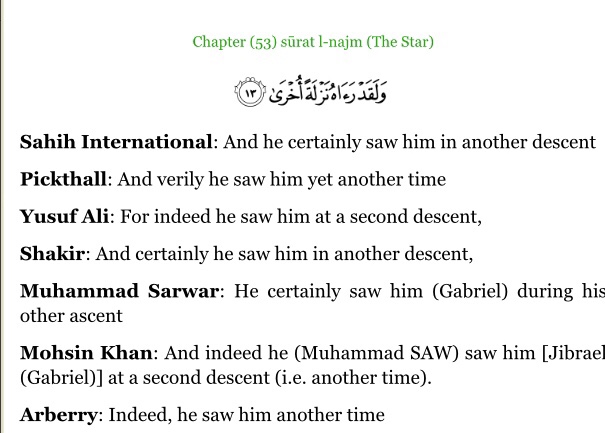
Again none of the translations make it clear that the above verse is also referring to the Prophet ﷺ seeing Jibril near the سِـدْرَة الْـمُـنْـتَـهَى sidradul muntaha. ( A Lote tree that marks the end of the seventh heaven, the boundary where no creation can pass ).
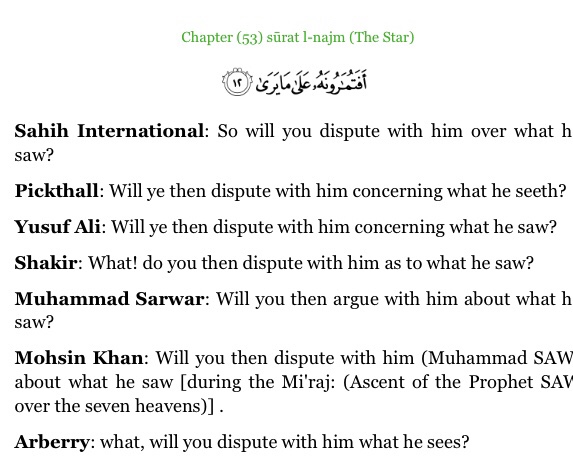
Only Mohsin Khan’s translation makes it clear that the context of these verses is the الإسراء والمعراج Isra wa Mi’raj where the Prophet ﷺ many things from the unseen.
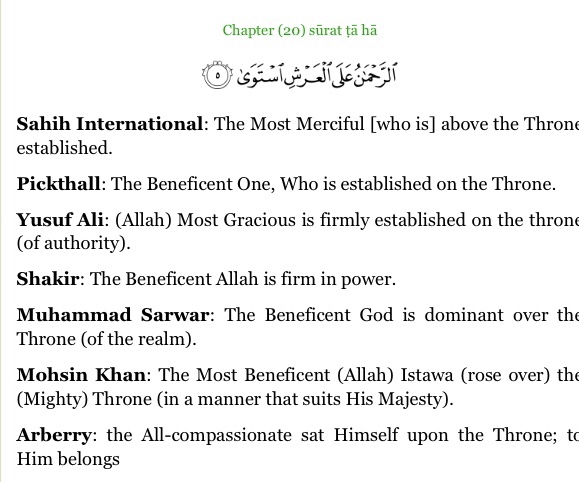
The majority of the translations again in the above verse err with regards to the correct translation of Al-istiwa’. Now the discussion around the meaning of Al-istiwa’ is a very lengthy discussion, however I will suffice with the following brief:
The people had several conflicting opinions over the meaning is istawa. However, we follow the way that our righteous predecessors took in this regard, such as Malik, Al-Awza`i, Ath-Thawri, Al-Layth bin Sa`d, Ash-Shafi`i, Ahmad, Ishaq bin Rahwayh and the rest of the scholars of Islam, in past and present times. Surely, we accept the apparent meaning of, Al-Istawa (rose over) I’ve, without discussing its true essence, equating it (with the attributes of the creation), or altering or denying it (in any way or form). We also believe that the meaning that comes to those who equate Allah with the creation is to be rejected, for nothing is similar to Allah,
﴿لَيْسَ كَمِثْلِهِ شَىْءٌ وَهُوَ السَّمِيعُ الْبَصِيرُ﴾
(There is nothing like Him, and He is the All-Hearer, the All-Seer.) ﴿42:11﴾ Indeed, we assert and affirm what the Imams said, such as Nu`aym bin Hammad Al-Khuza’i, the teacher of Imam Al-Bukhari, who said, “Whoever likens Allah with His creation, will have committed Kufr. Whoever denies what Allah has described Himself with, will have committed Kufr. Certainly, there is no resemblance (of Allah with the creation) in what Allah and His Messenger have described Him with. Whoever attests to Allah’s attributes that the plain Ayat and authentic Hadiths have mentioned, in the manner that suits Allah’s majesty, all the while rejecting all shortcomings from Him, will have taken the path of guidance.
A man asked Imam Malik (d. 179): “How did Allah make istiwa’ on the throne?” Imam Malik inclined his head and was silent until the sweat of fever covered his brow, then he looked up and said: “Istiwa’ is not unknown (ghayru majhul), the modality of it is inconceivable in the mind (al-kayfu minhu ghayru ma`qul); but belief in it is obligatory, and inquiring about it is a heretical innovation. You are an innovator.” And he gave orders for him to be taken out.
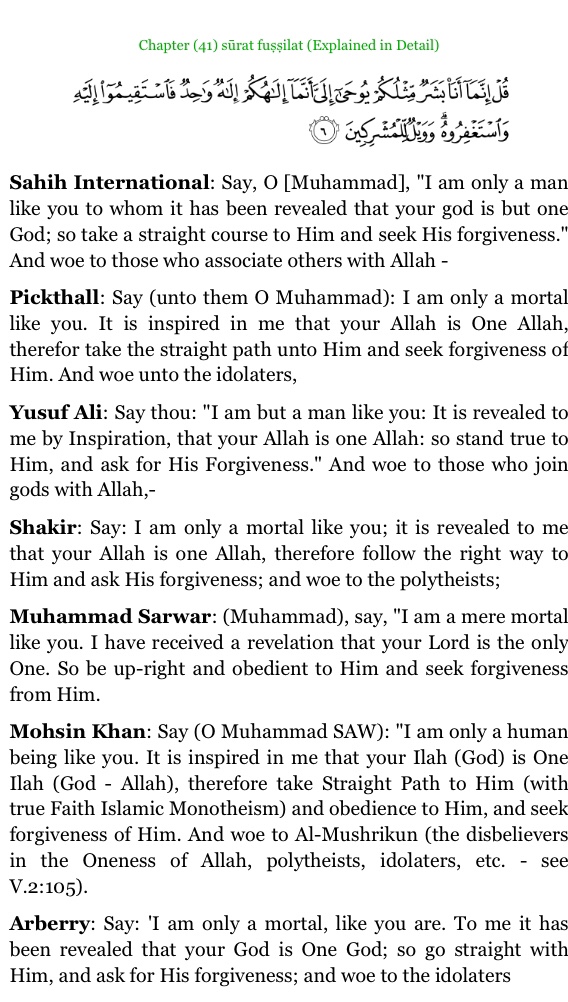
Again in the above verse we can see only Mohsin Khan’s translation makes it abundantly clear the context of the verse in that it is trying to emphasise that the Prophet ﷺ was a human being and from amongst those who he was giving his dawah to whilst he ﷺ was alive and to us (as his message is was all humankind).
Also if we look at the following verse from Surah Al Duha we can see a lot of the most common English translations have major issues, giving the impression that he was “wondering about “aimlessly, or “unrecognised”. Rather the aim of the verse is to give comfort to the Prophet ﷺ that Allah guided him through the Quran. The verse is also a source of comfort for us, when one feels lost or perhaps are facing hardship in our lives, then if one was to turn to the Quran, he will surely find it healing and a source of guidance.

Sahih international suggests the Prophet ﷺ was “lost”, suggesting multiple meanings in the mind of the reader, whereas Pickthall’s translation can be understood to mean that he ﷺ was “wondering” aimlessly “wandering” around until Allah gave him the revelation. Arberry suggests he was a man making many mistakes and “erring”. This is quite shocking, as we know the Prophet ﷺ, before prophet-hood, was regarded as Prophet Muhammad was known as a truthful and trustworthy person long before Islam. He was known throughout Makkah as “Al-Sadiq Al-Amin“: the Truthful, Trustworthy one, a title he retained even by those who disbelieved in him after he declared his prophethood. Which was one of the strongest proofs against the Quraish, as even though they regarded him as one who never lied, yet they belied him after he proclaimed the message of the Quran to them.
Shakir suggesting that he ﷺ was “unrecognised” by men, is quite preposterous, as we know that the Prophet ﷺ was from the best lineage amongst the Quraish and .
Wathila ibn Al-Asqa’ reported: I heard the Messenger of Allah, ﷺ , saying, “Verily, Allah has chosen Kinanah from the sons of Ishmael, and he has chosen the Quraish from Kinanah, and he has chosen the tribe of Hashim from the Quraish, and he has chosen me from the tribe of Hashim.”
Source: Ṣaḥīḥ Muslim 2276
It is apparent from the above few examples that many of the translators have erred because at times they have purely relied upon a literal Arabic translation rather then applying the correct tafsir methodology [3] to give the verses their correct context and meaning.
Finally, if we apply the correct methodology of tafsir and look for other verses of the Quran which explain the above verse in Surah Al Duha, we find the following verse from Surah Al Shura, which clearly corroborates with the Mohsin Khan’s translation:
وَكَذَٰلِكَ أَوْحَيْنَا إِلَيْكَ رُوحًا مِنْ أَمْرِنَا ۚ مَا كُنْتَ تَدْرِي مَا الْكِتَابُ وَلَا الْإِيمَانُ وَلَٰكِنْ جَعَلْنَاهُ نُورًا نَهْدِي بِهِ مَنْ نَشَاءُ مِنْ عِبَادِنَا ۚ وَإِنَّكَ لَتَهْدِي إِلَىٰ صِرَاطٍ مُسْتَقِيمٍ
And thus We have sent to you (O Muhammad ﷺ ) Ruhan (an Inspiration, and a Mercy) of Our Command. You knew not what is the Book, nor what is Faith? But We have made it (this Quran) a light wherewith Weguide whosoever of Our slaves We will. And verily, you (O Muhammad SAW) are indeed guiding (mankind) to the Straight Path (i.e. Allah’s religion of Islamic Monotheism).Ash-Shura, Ayah 52
In conclusion, it suffices to say that importance of learning the Arabic language cannot be emphasied enough, when it comes to understanding the Quran and also referring back to the authentic tafaseer in order to understand the context of the verses and when one does this they will appreciate the beauty of the Quran and its message.
Footnotes:
[1] Al Raheeq Al Makhtoom p129
[2] Tarikh Umar Ibn Khattab p.6
[3] The correct methodology of tafsir (exegesis) of the Quran is done in the following order:
- The Quran explains the Quran
- The Sunnah explains the Quran
- Explanation of the Companions رضي الله عنهم of the Prophet and the pious predecessors
- Explanation by way of the Arabic grammar rules
 Pearls of knowledge